måndag 8 maj 2017

Too late for spoilers...


"At dusk, as the polls are being counted at the end of this week Emmanuel Macron will be proclaimed the President of the French Fifth Republic. In this, he will follow Valery Giscard d'Estaing (stay strong...) as the only candidate not of the Socialist or Gaullist camp to have bested the last of contests since the May crisis of 1958 that swept the current order into its increasingly uncomfortable setting."

Thus I wrote, at the beginning of last week. And in this outcome - indeed, regardless of the outcome - the contest of last Sunday would have proclaimed the end of the order of the Fifth, heralding a new Époque in French politics whether a new constitutional document is inaugurated or not. For whereas Giscard d'Estaing, akin to every president until 2007 had been in politics under the stout general, the forces currently in the race remains virulently in opposition to this order and have risen to their places on the chariots on the promise of drastic change.

And if change is on the table, it may as well be regarded a fortunate answer to the call of history. The French economy, far taken from the Trente Glorieuses in its growing debt and long-term unemployment rate of double digits, abundantly so for the young and particularly ignominious in its isolation of the foreign-born from the open, white economy. Once the envy of Europe, centuries of post-Colbertian dirigisme has worked out not so well for the growing section of unemployed who may cherish the idea more than the reality, and will in the end end in the certain downfall of the Fifth Republic itself. Mirroring this gradual destruction of what was once the great power of the Western world, the Socialist and Republican parties both turned to outsiders with drastic, even visionary proposals aimed at revival and restoration of the glorious growth of former times (if not geographical). Untypically for Western democracies and by now even for France, they were vindicated in their respective parties, but ultimately failed in their grasp for the final prize, decidedly and with humiliation. Hamon's and the Socialist Party's stunning reduction, from a majority to a mere six percent of the electorate, will be remembered in the annals of the republic as the end of an era, which however was far greater than the party that produced two of its eight (lest more will follow) oarsmen. Fillon's, by the disease which consumes far more of the supposedly best of us, but here unusually early. This was a defeat to make Kim Campbell shudder, to keep Edwin Edwards from considering another bid.


Three for him to her one. A political analyst, I would not estimate her chances so highly... but the tide of the FN, almost imperceptibly and to the relief of many of my professional counterparts, has risen sharply since Chirac's Lukashenka-like figures in 2002.

The choice between Le Pen and Melenchon, who I previously chided for wishing to put humans first under an iron weight of economic chute (an accusation that, I think, must be reiterated for Mme Le Pen) would have arranged a contest between two who could not possibly reach the 50 % threshold except for either civil war-like circumstances, the destruction of Lyon by a suitcase nuclear device, or under such circumstances where the only option was the other of the two. Now, with a populist of solitude and a master of utilising la peur faces an elitist - though ardent in populist tactics, if not so crude as the term would evoke - in mongering hope, the result is all but determined.

Marine will make significant advantages, but even against the backdrop of a majority of Melenchon's supporters staying at home or dropping spoilt ballots, their support for Le Pen is as miniscule as might have been expected (though not from reading their programs) there can be not the scantiest of chances for the Front in its quest to liberate France from Eurocrats. Not on May 7, nor in the parliamentary election yet to come, in which even a quadrupled share of seats would mean only a fraction of its present two seats, added to Dupont-Aignan's one (always good to be lent the support of an ally who you may later discard for the wolves after skinning his five percent, a good showing, to the bone). Marine only has to swallow the bitter tears of defeat, and brace herself for the fact that she will, in my mid-election approximation (nearly) double her father's result against the "crook" Chirac. The Bonaparte-like tally of 2002, which I well remember with an instinctive sense of loathing (for whom, I cannot tell) was not up for repeat, and given the scenario which could have brought her victory already this year; who is to say she may not double it again in five, ten, fifteen years. The woman who will, to little doubt, continue her bid to be the first president of France is not that old, and still has many years to her father's last bid for a term at 79 in 2007 - after which he has all but survived two.


"... and then there were two. A big bear hugged one..." Or was it the other way? The one to be frizzled, alas, may return in 2022, and with a vengeance.


For the outcome was all but ascertained in the moment Fillon, the last candidate of Gaullism, announced the downfall for which he had only himself to blame. A last hope for the re-baptised Republicans, to replace rotted Fillon with old fighter Alain Juppé, could paradoxically have saved it for a new era. Sealing the verdict on his party without dissent, Juppé refused to break the sacrament of the primary which became become France's way, his downfall - and the downfall of the Fifth Republic, as we know it.

Yet there is in this new man supposedly of the left, the youngest Head of State since Emperor Napoleon in that defining summer of 1815, younger even than his cousin - he who was the first to bear the title president, the hope for a renewal mirroring that of the general whose name came to define a generation of politicians of the right. While enthusiasm has sealed a coalition that was broad enough to secure a landslide only doubted due to the pessimistic nature of the age - though, as I have said and will have to repeat, this was no repeat of the contest of November - it is too early to celebrate the Marengo, Austerlitz, Jena, Wagram, that remains irreversibly imbued in the comparison. (But imbued they are still, long after the downfall of father, son and ghoul-like nephew alike.) All that is certain is that the great game is still on, and the skills of this man not a politician, who unlike Blair - who twenty years ago rose to the helm of Her Majesty's government as the first, and only position in it he would ever hold (well... those of us disillusioned with Mr. Corbyn may well disagree outwards). 

Who will he select for his Prime Minister? The National Assembly is just as certain not to be dominated by the partisans of En Marche!, the best of results mirroring that of 1993, when the equally centrist, somewhat aloof Giscard's UDF movement swept to a secure second place behind Chirac's Rassemblement. A coalition with the Republicans, more certainly to become a plurality - if not a majority - than the wholly-disgraced Socialists (as I hope I made sure to predict in 2012, if not in clear-enough terms) would immediately discredit his leftist credentials, weakened already without the Melenchonist turn that has swamped what was once the Mitterrand coalition. The rest is in tatters, and may - if the trend remains and stability somehow joins hope and change in matrimony - claim a significant prize, but will still be a mere arm for the Elysée into the National Assembly. Alliances must be built, maintained, fed, and for the man selected by history, to make history, no choice of compromise spells godliness. The honeymoon which has not been long but intense will not last, and the first choices must well be made.


Look beyond the smiles of today... if a fraction of accusations lately leveled in smear are true, and Republicans increase their hold, there might be a Clinton treatment in spare for the youthful unifier and centrist. Were Macron to be impeached, conservative President of the Senate Gerard Larcher (right) would assume the Chateau in another first, and the man to his right (so to speak) could mount another, yet more implausible grab.

How the parties of establishment has chosen to respond, being aware if not convinced of the outcome long since, will be equally interesting. These are men well accustomed to power, and where it must be shared, they will fight for every inch already claimed, and for good reasons. Strong men of history are seldom beautiful in the making, often horrendous when at work, and imperial only when safely separated by at least one generation. Macron, while having presented a program that would prick few bleeds outside the core supporters of the Front and the Megret-Dupont-Aignan-Villiers throng, holds no loyalties and few questions of heart. His initiative to invite climate change scientists was typically audacious (though I would prefer them to work with Governor Brown, and other giants of the resistance which will one day define America as much, if as falsely, as the French one) but with a favourable zeal. 

That question cannot be ignored, and if the research and development required to parry it will benefit the long-stagnant French economy as well, he may truly achieve greatness, perhaps even in time for re-election. Not that I will pass any verdicts there; the future is best left unspoken until the sun of today is in the setting, but if Macron finds the courage (and, indeed, the support) to run for re-election, I would not mind to bet for a re-match. One might thus hope for an Eisenhower-Stevenson setting, though the case of Mitterrand-Giscard seems eerily possible. It took time to build the present Socialist party as well, and for all the substantial opposition, the time may work as well in her favour.


A resistance that will not be quelled. Chirac's figures were stronger still, and his second term was not one of much more ease, with scandals undercutting his supposed image of a statesman. And yes, for all the imbalance between the insults, the lady may return like the Louvée de la France... with a terrible vengeance, that is.

The words have been said, the figure pronouncing them heartwarming but somehow meek in the hour of grandeur. But what is equally true as the significant gains of the Front - if not as significant as might have been the case with Fillon or Melenchon for an adversary - is that the opposition, having won the argument amongst the proverbially disenfranchised, the aggrieved minority, will only continue fester and grow, and grow... and grow. Unless he triumphs.

Ours is not a time fit for heroes, for all the cheers of the night passed into subtle brilliance before the night sky and the peak of the Louvre, now with a somber solitude to its predicament, like a blunted knife lit in commemoration to praise its former glory. But in time, even a shrewd and reckless man - the creator of the Fifth Republic being the prime example - may be saluted for a hero. Let us hope, and not without a certain conspicuousness, that the man who has once again clung to the ladder of state by embodying hope and change will succeed in wielding power as in claiming it this era of meek conservatism and stagnation, and in so doing proves to be as shrewd as those who made him, and made him so desired. Only then may he actually outlast it.

lördag 15 april 2017

Déjà Vu, Déjà Vaincu


[Krönika författad i november 2015 för Västerbottens-Kuriren med anledning av attentaten i Paris, publicerad nu. Kosmetiska ändringar har införts, men texten syftar till ett perspektiv utifrån veckan 16-22 november 2015.]


Kvällen den sistlidne fredagen började jag skriva en krönika om terrorism och den konflikt mellan sekulär humanism och religiös fanatism som framträtt i tomrummet efter 1900-talets söndertrasade dikotomier. Jag var halvvägs innan nattmörkret sänkte sig över Paris och nyhetssändningarna som följde. I skrivande stund räknas 129 döda, en ofullbordad siffra, i urskillningslösa skjut- och sprängdåd. Helgens scener är de värsta sedan de tyska trupperna uppgav staden 1944.

Men det är inte utan urskillning som terroristerna valde sitt mål. Paris; där Voltaire, Diderot och Montesquieu verkade, slogs, lades till vilan. Paris, där den första sekulära republiken (efter USA) upprättades över Bastiljens, absolutismens och klerikalismens ruiner. Paris, där Karl Martells grav påminner om det nederlag han 732 tillfogade det första kalifatets arméer vid Poitiers - den vändpunkt Hitler långt senare beklagade sig över. Frankrike, som häromveckan ställde in ett möte med Irans Hassan Rouhani sedan denne insisterat att profetens diet - vatten, inte vin - skulle gälla vid konferensmiddagen. Sedan incidenten upprepades i januari var de excentriska undertonerna i en borta, i en stad där barer, restauranger och en konsertlokal beskjutits och det förbjudna vinet blandats med blod. De sedan länge förruttnade likens livshållning och dogmer, påtvingade de levande med olika grader av förmaning men likadeles utan urskillning.

Ty konflikten som utspelas i Europas hjärta och på dess tröskel representerar allting jag föraktar och allting jag älskar. Lösaktighet mot sexuell repression, social och vid knivseggen, laïcité mot sharia, tankeväckande satir mot tankelös recitation, nationalförsamling mot nattligt samkväm med ärkeänglar som lagens källa. Kärlek till livet och förhoppning för döden. Och andra krafter mobiliserar. Med stundande regionval kommer dåden som en vitamininjektion för de som söker dela landet i jihadister och nationalister, ty när slaget kommer vet båda sidor att segern är given. Detta andra Poitiers, inte siffran 129, var hela syftet.

En anekdot rörande salafistisk terrorism, dess dödliga fascination med det första kalifatets vanor och livsval samt dess ömsom diaboliska, ömsom tragiskt fallna medlöpare förtjänar att upprepas. 1785 besökte Thomas Jefferson ambassadören för de nordafrikanska barbareskstaterna, den terrorstat som i det Osmanska rikets sönderfall uppstått på Europas tröskel. Ämnet rörde europeiska och amerikanska sjömän som kapats och sålts till slaveri i Mellanöstern (omfattningen var i miljontal, enskilda ättlingar måste i dagsläget vara på väg "hem", om än utan att veta om det). Ambassadören, hellre än att kritisera misären i Paris' förorter - värre då än nu - eller amerikansk utrikespolitik - ett ännu okänt fenomen - försäkrade Jefferson med månne berömvärd uppriktighet att "alla nationer som icke erkänner profeten är syndare, som det är de troendes rätt och plikt att plundra och förslava, och att envar som stupade i detta krig säkerligen skulle gå till paradiset". En ursäkt som, med tidsenliga komplement, ekat genom historien.

Ambassadören, i en icke unik gest, antydde sig villig att avstå plikt och paradis mot kontant betalning. Jefferson lovade varken guld eller Hollands uttalat "skoningslösa" gensvar. Men veckor efter hans tillträde som president seglade en armada, som i samverkan med en svensk flotta under Rudolf Cederström och grekiska och arabiska legosoldater reducerade barbareskstaterna från kart- till historieböckerna. Zapatas ord ekar också genom historien, sist av den fallne Charlie-teckaren Charb: Det är bättre att dö på sina fötter än leva en livstid på sina knän.

* Så även när incidenten upprepades i januari följande år.

söndag 12 mars 2017

The prospects for a French sixth republic... and the brief case for a Dutch one


The month that within soon may be described with an uncanny "next", the creation of general De Gaulle will face its greatest, most defining upset since the time the general himself resurrected the Bonapartist system of a direct, national poll in his momentous struggle against Monsieur Mitterrand. That stunning struggle which lasted well beyond a single day but came - beyond assuring both men's place in the national curriculum - to complete a political culture, a hybrid of the American presidency and Anglo-Saxon parliamentary rule, which has since been the pulsating heart of the Fifth Republic, itself surpassing the Third as the longest-lived polity since the Bourbons in a mere eleven years.

But then, if there is an uncanny reason for doubts about such a virtuously unpunctuated "end" to millennia of upheaval and radicalism that has defined French history it can easiest be narrowed to the current polling statistics, suggesting the downfall of the legacy of both men, of the political vehicles of French Socialism and Le Gaullisme, of the France we thought we knew politically. Indeed, if the figures of today are to be believed, the struggle for the Elysée Palace for the next five years stands - as they have, bar the infamous year 2002 - not between Socialist and Gaullist candidates, who look likely to be thrown out in a stiff reenactment of the Austrian upset of the last year, with the world's third largest (self-acknowledged) nuclear arsenal in the pot, along with a permanent membership and veto in an increasingly hibernated United Nations Security Council.


Long gone, from the Elysée and shortly into the soil... now, after decades, fit for burial?

The untypical - and, I have to say, desirable - end of major party politics that have come to define the contest of the spring, with the unpopularity of past Socialist and Gaullist (whatever the acronym of their hosts) administrations blowing home with a chilling rain of low digits. For it looks, partly in light of Mr. Bayrou's brave-hearted defection, as if the inevitable competition of May 7 will feature Emmanuel Macron, maverick ex-Socialist, darling of "alternative" leftists and rightists alike and increasing clot who despise both labels contre Marine Le Pen, Dauphine of the old devil of the nativist right, Jean-Marie.

And while Mme Le Pen has made - as well as endured - a real effort to present a different face than that of the old devil, a riffraff of post-war ultranationalists, Third Positionists and identitaire movements mashed up with post-Poujade Poujadistes and Catholic conservatives, she remains villified by the bulk of an electorate which only fifteen years past rejected her party label in a historic, 82-18 upset. By the estimates, Macron as an alternative - arguably the strongest - would see this upset reduced to approximately three-to-five. Arguably a stunning victory for democracy and the liberal order. But, again for those who will remember the year of 2002 and its Napoleonic tally, a striking reduction in enthusiasm.


The minority report...

And because Macron seems to greet history with a hand more safe, more sensible, more pragmatic and (ironically) appealing to the continuity of the existing framework, he precisely represents vivid and very real uncertainty. And it is this uncertainty which, appealing to a growing portion of electorates throughout the Western world - the world of Western democracy now turned against itself to a degree not seen on this side of its most contentious trials, unites the forces rallied against it. Macron, while undoubtedly an optimist, a globalist, a disciple and servant of the current order and its giants, may yet be distinguished as a "strong man of history" of which France and French republics has spawned its handful, all of which have been known to add a number of order to its incarnations set to take its next step, as proposed by perennial-to-be candidate Jean-Luc Melenchon. If five, why not a sixth?


Champion of the dispossessed, the outsiders, those desiring to overturn the current order... gazing towards a future we can infer only through its reflection. Learn to determine the visions of your forbearers, and to practice to reflect before you select.

For the darling now expected to best the devil is nothing if not a man of contrasts; a leftist minister, a reformer and radical - yet with the blazing, glaring face of a self-made man, a man of no loyalties, no party, a maverick connected solely to the hearts and minds of his audience, whose commitment he commands as a most skilful conductor. A servant of the Socialist party with credentials of the Hollande government but also an uncanny (for those complaining about the rationale of President Trump in selecting his cabinet) self-portrait of a vitalising outsider with a resume pierced by the glittering punch-clocks of Goldman Sachs.

Edging him to left and right, dogged by the sins of affiliation and oblivion - in Hamon's case - and of yesterday of vain avarice - in Fillon's - there was the prospect of a genuine dialectic; the drastic slashing of public expenditures and public employees against the taxation of robots and implementation of a guaranteed minimum income, including to the hibernated and badly investment-needy overseas territories of Reunion and elsewhere. The near-utopian radicalism of the pre-Mitterrand left, fitted and concerned for the conditions of tomorrow against an unusual mixture of liberalisme (here, just as in its revolutionary cousin, an invective) bordering Thatcherism, reminiscient rather of Poincaré and his likes than the long-overdue Gaullist project. From these drastic calls of left and the right, a genuine path of progress could sordidly needed could have emerged, with audacity and idealism as its much-needed platform.

Rather, the young David called to challenge the brutish ogre (or Saint Jeanne, if you prefer) seems more reminiscient of the American president in this refusal to play politics as dialectical struggle of ideas and reform, substituting a call, if not a shriek, for revitalization - with a palingenetic quality - over politics, Gaullism and Socialism, classes, left and right, even calling for the filling of a void left by the decline of the Bourbons and its lightweight successor of Bonapartism, and its later incarnation, the collapsed "imperial" presidency of the Fifth republic, washed out in a tide of meekness, corruption and stale parties reminding only of the consumed times and blue skies of earlier times. Echoing the visionary bluntness of the Clinton campaign - to which I could extend reluctant support - the enthusiasm on which the En Marché movement is built holds a humiliating scarcity of goods, and extends promises deliberately constructed on the numbing comfort of opacity and the blazing zeal of change, pitting the forces of good, progress and hope against a petrified establishment.


A moment to be remembered... but her ambitions may yet burn her. More often than we like to admit, the Cauchons and Bayrous of the day remake the order of tomorrow.


Spelling out a simple but dramatic truth... in the last polls, Hamon has surrendered his shameful fourth place for Melenchon's movement La France Insoumise.

Given this dialectic of personality rather than program, there is a bitter echo of the presidential contest of last November. As for the outcome, as stated, it will rather prove an echo rather of the Austrian presidential poll of December, with the clear message of traditional standard-bearers defeated and humiliated by strong personalities - of different kinds - and surging forces among both left and right (whatever these labels mean). Macron will be upheld not foremost as a champion of something new, but a defender and amplifier of a conditional order against the hordes threatening its very groundwork. And thus, there may be every reason to question his rise as a different facet of the unprecedented and groundshaking - now it has to be said - progress of the Front of the old, seemingly vanquished Diable de la Republique. This new political order, built on negatives and strongmen (and at a long last -women) more than before jostling for position, now against a backdrop of calamity should the alternative emerge as victorious is saddening regardless of outcomes, and promises for nothing if not surprises. Against this, there is the case for a renewed streak of proud French traditions of the intellect and dynamics of ideas, which will hopefully provide new mindsets of left and right, and new dimensions and divisions, of which I can only sordidly miss that of the climate, which - subsequent to the Paris agreement - seems to have faced a spectacular backlash.

Given the recent supposed upset of populists and enemies of European integration in the Netherlands there has been made a case for optimism, but this is a comparison without appropriate pedigree, which foregoes the success of Mr. Wilders' party and the foreseeable conclusion that no coalition under his leadership could likely emerge. Given the proposed riddle of the Dutch state and its perceived foundation on joyous carefreeness and Enlightenment values, I have only one thing to say. The Netherlands of my migrant forefathers arose from the broken shackles of Habsburg imperialism and monarchical corruption, and flourished under the auspices of then-audacious republicanism, as well as an unprecedented and unchallenged freedom of press outside Britain and Sweden, the bastions of parliamentary rule. If France - joined in the future mayhaps by its southron neighbour - has thrown off its shackles of the Bourbons and Bonapartists, and will preferably keep them off should Macron (preferably, and with greater likelihood) emerge along the steps to the Elysée the following May, there is a case to strike a blow against the authority on which its stones were laid in thought as well as practice. The oft-spoken liberal creed of a collection of Dutch states was founded on republican values, and if there is a case for a call to restoration, it is also high time to reaffirm that fact by restoring the stewardship of state to the proud Dutch people and its Staten-Generaal - the first word compound, in its French translation Etats-Generaux, here shamefully if understandably transmuted - to be held close in mind by the assembly which will not only serve, but safeguards the future of the next French president and the French state, whichever its form and numeral.

lördag 12 november 2016

The Experiment within the American Experiment

The Trumpian grab of power - or by the power - juxtaposed to the invaluable reduction of Republican power in Congress may have come as a shock, but beyond the certainty it now poses, it begs the question, and indeed answers, of the loyalty of the Republican party to its most deep-held principles. The case the foul, but simultaneously continuous effort to annex the centre stage of this party and in the process subvert the these principles (accidentally or profusely) and turn country into something much more reminiscent of Viktor Orban's or Lech Kaczynski's vision of the national-Christian authoritarian state - just scratch "Christian" and any authentically American sense of nationhood - has subjected the party to a simple but potentially shattering test; a test that may shake the world. What will the Trump court, presiding over a grudging-to-enthusiastic Republican cartel and an unruly, as well as unruling, mass movement of Trumpians - or "Kekists", in disguised honour of the Egyptian god with the frog's head, but more importantly to de-emphasise the phenomenon from its non-creator and current darling - accomplish in the half, or rather full term to come? (I do not expect the Senate to swing into a Democratic majority in 2018, though one might well indulge in the hope for the tsunami it would entail.)


And what are you looking at...?

I do not think, however, that it is time to herald the destruction of all that is decent in the Republican party. Indeed, and echoing Sam Harris' gambit, I thought I would rather have taken a Kasich administration or a Paul administration - even with the possibility of a Republican-majority Senate and the near-certainty of a Republican House - without doubt over a 50/50 coin toss between the offered candidates (the numbers, as you may recall, were far better). But it is time to look back and to reflect; would a proto-Kekist character of demagoguery and the politics of decisive, utmost division - even with the record of a governor, and loving husband of one wife, three children and the occasional slip of tongue or opportunist "evolution" of views (though not necessarily the subject of evolution itself) and stances - have claimed the nomination in 1992, or 1980, or 1964? (In the case of the Democrats, we shall not fully know whether it did, or whether a speck of lead and the effort of Paul Bremer made the difference.) I do not say that the character flaws of the man who is now president-elect (or who will be on December 19, beyond the audacity of any bet) as well as inarguably one of the most successful con men in history, are beyond comparison. But one has to return to an age before the decision to vest a nuclear arsenal into the American one-man executive to find the sentiments which rely on opportunism and rather than Taft's hands-off exceptionalism and stand on principle - which included his courageous and virtually lone stand against the outcome of the Nuremberg Trials, and the more-than-questioned legality (to be distinguished with legitimacy) upon which it rested.

The best conceivable scenario may indeed harken further back, to the redefining surge of Warren Harding, which I will return to. Unfortunate, as we are to know, the Donald will not be an ignominious, but soon-to-pale mock repeat of the Goldwater effort in 1964 (though, given the implications of that comparison of a later, more advanced and successful repeat of that effort, I would perhaps prefer the present to a successful Trump, or Bryan, of greater ambition and capacity in 2020 or 2024).


Last century's model? Or precedent?

Harding was indeed laughed out, an extrovert figure with a shallow charm, a warming wit and mild interest in the machinations of governing, which he handily left to his cronies - in fairness, a set of such illustrious minds as Charles Evans Hughes, Herbert Hoover, Harry Daugherty and Andrew Mellon, who successfully steered the United States into the early years of the roaring and peaceful, reassuringly bloated 1920s. I much reject the notion that even a united Republican party successfully united would be able to successfully withdraw from world and conflict and both as Harding did, and repeat the economic miracle upon which his memory ought perhaps be remembered. And if you think it merely incurred a debt of suffering for fellow humans, living and yet to be born, then look to his undeservedly forgotten speech in Birmingham, where for zero political gain he called for equal political rights to the cheer of the segment of the population to whom few would look even for tacit support.

And for those who think the race was all about but race and the preference of any man over a particularly colourful and ambitious woman (this being literally true of course, though not in the positive light herein stated). In the case someone cannot read it due to monthly restrictions (and thus doing well with your news coverage; if not up for subscription, do check into The Guardian while it's still doing its civic duty by being free of charge), I will quote a succinct piece;

Instead of bias, what animates these voters, whatever their race of political orientation, is a profound distrust and resentment of wealthier, educated Americans, a group they say lacks a connection to them and does not care about their economic situation. And to them, Mrs. Clinton seemed at least as elite as Mr. Trump, if not more so.

Two sentences to speak life stories and the hopes they fuel. And these stories are both legion and disturbingly "European"; see us now. We are real. We are dissuaded by a two-party system. We oppose and reject (as in repeal and replace) the globalised economy and trade deals that merrily ships our jobs overseas, as we will not. We reject multiculturalism which has not only subjected us to demographics change, but now an authoritarian brand of cultural radicalism. If someone moves to our edge of the bar, we will - in the end - respond to the advance, rather than Hemingway's proverbial rejection of death, and a surrender to obscurity. And if the offer means lighting the rest of the bar, our fears, hopes, desires ablaze, we will readily offer the flame - end of figurative quote.

None of these points are without justification, but all have been tried and tested in practice, usually to the detriment of the party - Denmark being a good exception to the rule, which has swamped both the partisan system, replaced the established conservative party as the long-term conservative option and self-handedly dragged all others into a new paradigm. But with the GOP - long conflated at least to the history-blind and more generalising surveyors to the sentiment that has permeated collectivist-populist parties not-of-the-left, but with a nostalgic view to the welfare institutions, the security, the general sub-national society of the mid-1900s - acting as host, it could be devastating to the world economy as well as geopolitical realities.


Five reasons or repudiations

But, more broadly speaking, beyond this single story - which you ought all read, to inspire some predictions of different futures as well as empathy for the average rust-belt Trump voter - what brought us here? In short, 2016 was the story of five repudiations; a repudiation of the globalist neoliberal economics, the perceived decline inherent within its duration, its maintenance by an unimpeachable two-party duumvirate in spite of the likewise perceived interests of the (Northern, South-of-Canada) American worker, and overall the desire and hope for this policy to be reversed, the arm of the clock turned neatly back to Mr. Perot's menacing statement of a great sucking sound.

Second, a repudiation of identity politics and the rise of a counter-balancing, very much ragtag, but also very real and even intellectual... sometimes... brand of white identity politics focused on a distrusted and increasingly marginalised, soon-to-be minority WASP bloc under perceived (and, as far as facts go, very real) siege, and the recognition that if there is a racial as well as cultural clash of views coming up, they ought line behind the one vote perceived, and sometimes hootered by the left, as their representative.

Third, and more importantly for the world stage; a repudiation of the consensus upholding the global world order under the American empire and its perceived missionary status in world affairs, of top meetings, climate change debates and bombs over deserts turning to Jihadis requiring more discussion involving more bombs, the seemingly exhausting cycle paid in dollars as much as blood and flesh. The repudiation of Wilson, Truman, Reagan and, yes, Obama in favour of resurging isolationism.

Fourth, and equaled on the other side of the partisan fence but for more temporal reasons - a repudiation of Clinton, of her name, her husband and their ilk, of political dynasty and political professionalism (this ties in neatly with the first argument, and the near-messianic search for Change).

Fifth and finally, a repudiation of the Hayekian thesis of rules, not rulers, which I consider the epitome of the American spirit, as we knew it. We need a fixer above the system, not a fixed system (my quote). What could be more un-American, let alone anti-republican?


Trump's and Clinton's starkly different Americas. A nation divided against itself - but will it stand?


Of this attempted reversal of seventy years' of orthodoxy (arguably not well-represented by the likes of Nixon, or even Reagan) by an Independent candidate of a populist brand, or rather one entirely his own, effectively wearing the garbs of an elephant in order to neutralise its candidate and thus an unpredictable (but predictably two-party) race, the one I am certain will fail is the supposed reversal foreign policy in nostalgia of the age of peace at home, non-intervention abroad. For this, the Republican Congress will certainly prove an obstacle that will not be conquered in the upcoming term, and has every ability at its disposal to impeach him. Speaker Ryan may not be easily described as a neoconservative, but as shown clearly by the candidacy of young Marco, the brand of not only American exceptionalism and power, but "restorers" crying rather for a Reagan-era of fledging supremacy and conquest of space (last harkened by the possible next Secretary of State Newt Gingrich, alongside a "a clear-cut idea about America's enemies" supposedly of Andrew Jackson's brand, a recyclable, breathing time bomb criticised in his day not only by Thomas Jefferson, not only for his harshness and bad temper not only towards the native population of the country, but English POWs protected by the Jus in Bello as well; "Kill them!"*) is here to stay as well.

Which Donald Trump then, given General Jackson's tenaciously mortal state, is the American people - and the world - going to get? What was purchased, and how long will it last? With what has already been stated in mind, I move on to ideas, possible and unlikely.


The Pinocchio

The perhaps most likely course, and easiest to envision. The role of either wooden or puppet seems to go in spite of everything that seems apparent of Mr. Trump's personality. Likewise, as far as his ambitions may already have been reached, and in light of the presidency's need of congressional support - which, bar cooperation bordering submission, would be hard to secure - he will have to coalesce to both the Trumpian throng and congress Republicans, with their inherent many factions but broad strokes not sympathetic to the vies of a radicalised mass movement. The latter will be considerably easier to placate, with symbolic concessions viable with large segments of the Breitbart-reading ragtag faction, such as appointments, statements unaccompanied by policy, starker measures against immigrants with (proven?) criminal records, an extended fence along the border of "wall-y" features, a threat to allies to increase their defense spending - arguably among the most dangerous things he has said - a flying carpet descending slowly over the last strongholds of the alleged Caliphate in Raqqah and all its works, a freeze on further global integration (for now) and a barking threat on a review on NAFTA, the last would prove a red line for a war with Congress. Alternately, such a move might precipitate impeachment proceedings, which once commenced will easily end in defeat. Democrats will only be held back by the threat of the alternative, and any better legal excuse would sway them. Enter President Pence, with a proudly shorter nose, limbs already clattering as they move in unison with too-apparent strings.


The Silvio Harding-Grant

It is true, as I stated, that Harding would be the ideal example for a Trump presidency, and in spite of the Ohio Senator's likability and lack of strongman ambitions, such as his lack of enthusiasm in the nomination, the comparison is not without justification. "USA First", "a return to normalcy", the repudiation of Wilsonian idealism (but certainly not all of his agenda) in favour of domestic policies and domestic growth are all concerns for the new Republican coalition - a phenomenon only partly overlapping the party's already crowded factions, and the relation between the voters and votaries of the administration and their supposed brand will be tested.

I pray, do not take them for different branches for the same agenda, I predict they will clash as much as conservative Democrats did in the lead-up to ObamaCare, and perhaps place a President Trump in the seat of Obama, without any of the ex-Senator's intellectual or political capacities, which I admit have been considerable (and beneficial in almost every regard but the continuing deficit, which I hope would have been quelled under his successor). Whether this clash will be or the catalyst of a catastrophic meltdown of support, with Trump's temperament married to the immense powers vested in the Commander-in-Chief, or mere puppet to more ambitious (if not more illustrious) men of lesser acclaim with the Populus, we shall yet see. This approach involves less controversy than most followers of the campaign would expect, but may not work out too smoothly with his (supposed) intra-partisan allies - which may yet see the response made against Tyler or even Andrew Johnson - disownment or impeachment. The latter may seem dramatic, but was predicted by the not yet discredited Alan Lichtman, and given the factual basis for it - as well as the half-baked attempt already made - not entirely without justification.

Regardless of which, let us throw in Johnson's (actual) successor. The eighteenth president of the United States was an unprecedented hero of his day and profession, but has largely been forgotten. In his heyday he was praised, beloved, entirely without political experience and, in lack of a more conclusive summary, trumped by his many mistakes - most involving less forgivable mishaps committed by his appointees, a phase that is already being carefully studied and almost certainly will lead to controversy. With further lawsuits coming up, regarding scrupulous affairs of both kinds well-known to prestigious male politicians, is another feature we may yet see. Throw in a few shady deals, a press beacon of lubricious scandal, continuous appearance in the court, and cosying up to offshore dictators and the upcoming administration might rather be compared to Italy's Silvio Berlusconi, unlikely ever-resurgent strongman and vindicator of the populists who now - I think - seen his demise. (I bid, however, that his face never shows up on the $50 bill.)


The Chavez, north of the Gulf

Given his New York City origins, his brash style and strongman personality, I was tempted to name it "the Teddy Roosevelt crybaby", but decided that core ideological and personality differences were too stark, if not overwhelming, to merit the comparison. But certainly there is something in common which may be felt also with the more contemporary example the late Venezuelan strongman, who came from unlikely beginnings, without political interest or experience, to rally against a dysfunctional two-party system with militant demagoguery, including a coup de-legitimising the existent framework before rising on the back of its disgruntled to conquer and explode it from within. A new constitution, a new legislature (with an abolished Senate), curtailed power of the courts, an entire new party scope - until his last agonising months dominated by its creator - and re-naming the country after his favourite dictator (literally, as I have stated in my previous post about his disciple's last, controversial re-election).

Trump would, to small doubt, want to achieve many of those points, and may wage a constitutional war using the masses who lifted him to prominence. The benefit of the American one is the refusal to admit a national poll, most often discredited given the increasing number (now five) opportunities for the electoral college to trump the aggregate result of state (and district) polls, which could hypothetically be called by Trump, and preceding administrations, to bypass the will of Congress. Given the often fluctuating turnout - which should be the Democratic party's main priority - this should be considered a democratic as well as political blessing. Trump's tools to upset a system far more established, and still held in greater regard, are restricted in ways the Hugo's were not, and if he has stimulated cohorts of following, from frenzied young men to middle-aged women openly inviting his audaciously versed advances, his following its capped by legions of reluctant voters of self-interest, from the professional unemployed to skeptic middle-class core Republican, both of whom will turn their backs once they realise how deeply they have been screwed.

The question is what will be between now and the defining moment - in Chavez' case, quite a lot - and what will be the less peripheral consequences. How the path is paved, given the obvious and already-seething conflict of interest between committed constitutional conservatives, state-level moderates interested in growth-through-pragmatism, quieted Tea Parties and their Senate scions, and the Kekist zeal of revolution and pre-apocalyptic faith in government (what could be less American, and harken better its past greatness?) is yet to be seen.


The The Donald J. J. R. (Tolkien) Ewing Atreides

Emphasis on the last name, if you don't appreciate the purely surreal. Trump rose from a staircase of backs of the small, bare-footed, small-town conservatives dissatisfied and often ignorant about far-away wars (my last reference to Tolkien, and merely a semantic stepping stone). The movement he has crafted, now grown into a fully-fledged coalition as separated from its oarsman as from its part-Tea Party pedigree, is no more his creation than the cataclysmic changes within the Republican party occurring since the Bush years, but has already shown to transcend it. If Trump had emerged as a trapped Guy Fawkes on the early 9th of November a further, more successful darling of the Kekists - though mayhaps sprung from his own loins - could less surprisingly have emerged from the muck overshadowed by an ineffective, politically compromised Clinton administration.

Either way, and echoing the words of President-elect Matthew Santos in an alternate 2006, the vision starkly professed, and at any rate believed by the disciples of the green ruler will outlast the Trump administration and be a core feature of his legacy. The potential of a Donald Atreides, without the hair, the vulgarity, the accent, straddling and straining a powerful movement of more than bleating frogs that can truly challenge American constitutional democracy.

Bringing us back to 2016. At the height of summer I asked, predicting (and perhaps failing to segregate prophesy from a degree of desire) a Clinton victory and the continued decline of the Republican party onto which path the Democrats - with their many factions and failure to articulate a clear agenda for the continued progress or existence of the American experiment - would lead not merely their own country, but the world. Now I ask the question again, from the fractions of division rather than lack of enthusiasm or zeal; whereto, now that the Republicans want to lead? Given that the multitude of answers is sure to tower over a singular one - the latter being impossible even with the most successful, and harrowing, subversion of the party to the whims and frenzy of a sure-to-be fragile Trump coalition - how far can it lead? In reflection of the answer which was never given in response to an aggressive, conservative caller to CSPAN regarding the claim that the Beatles "wrecked this country" - if it could not survive the dreaded hair and vocal abilities of Ringo Starr, it was not a country worthy, or remotely possible to preserve. If Emperor Donald, which by then he must be, survives the Constitution it was a document failed as it was written, except as poetry. The American experiment predated it, and as known from the debate which included a model closer to the one that emerged in Maastricht - or Vienna eighteen decades before - and may survive it as well.


* In fairness to Jackson's temper and presidency, I believe both served in the cause of the most drastic expanse of the suffrage which has ever taken place, rivaled only by the efforts of Johnson, Grant, Charles Sumner and Thaddeus Stevens, of Wilson and the brave and tenacious supporters of the 19th Amendment - which, however, had been an ongoing struggle for more than a century, since the days when women of New Jersey could vote on equal terms as their male peers and Thomas Paine called for female emancipation to occur as well as part of the greater American revolution of mind. For this, further generations, including names mentioned, owe him and his temper a grudging hiss of gratitude. Consider it earned, every time you see the portrait, and let Winston suffer no more.


tisdag 8 november 2016

Comments on the Election, before the Ballots Fall (in December)


Having waited for this moment for long, for good or for worse, the contest which has been constantly in motion, yet (at least for those who, the summer before last, took the polls predicting a Clinton-Trump contest for what they said)


The electoral map, 538 to go.

Whosoever dismisses this criticism - articulated and available freely for anyone who dares to look - on account of Clinton's sex must be able to claim either immensely limited knowledge on the resume of their professed favourite candidate, a highly selective memory and cognitive capacities, or a personal ethic in line with Mr. Blagojevich's.


The scenario I mused about in my last post. With an unlikely red delegation in New England, and the Utah delegation in an odd, since the year of De Gaulle unprecedented third colour, the scales could remain locked, the contest determined by the House.


My expectations - sorry Evan - give or take a state or two. I must say I'm iffy about Florida, Nevada and North Carolina; the latest polls have suggested the latter to return to the Democratic fold. But in solemn recognition, if too early a vindication, of the growing importance of Latino voters in the first two, as well as current trends, I would expect them to remain in camp blue. Which, if forecasts from Ohio will mature into reality, will herald the first since 


måndag 17 oktober 2016

A Three-Way Race, and Other Outcomes


The response of Donald Trump to criticism of his sexual conduct, or proclaimed habits of misconduct has, arguably and unbelievably to many if not those floating the verbal abyss of unconditioned zealotry, masked as political preference, received a stern – I would say unprecedented – rebuke from president Obama, who in no-nonsense terms has proclaimed "democracy itself" to be at stake on the eighth of November. Not for the first time, and for reasons that for the reasons unmentioned should arouse concern rather than sheer disgust, I echo some relief at being unable - as well as reluctant - to cast a ballot in this last of contests of a racket reality show of an electoral cycle - well, unless turning your attention to the senatorial race and its adjoining debate in old King Louis' country - a cycle now depreciated to the utmost depths. Only the further decline of both parties is assured, and with it hopefully the tendency to promote candidates more in line with the popular demand and able to mobilise these in an optimistic as well as zealous effort.

But that these are strange and surprising times must be reassured as well as repeated, and in theory as well as in a future imaginable a third option could herald the possible - I must say I considered "covetable" - defeat of both Clinton and Trump, a challenge from dismayed quarters (RedState.com and Mr. Kristol being my usual suspects) who last August filed papers to put the well-spoken, if politically inexperienced and abysmally obscure 40-year old Evan McMullin, a Mormon and former CIA operative with a neoconservative streak, a TED Talker and worth watching at that, in a late counter-challenge to the seemingly victorious Trumpian effort to subvert the Republican Party.


"The constitution is great, but it doesn't necessarily give us the right to commit suicide... okay?"

You know who said it.
(A question for Justice Scalia's eventual successor to ponder.)


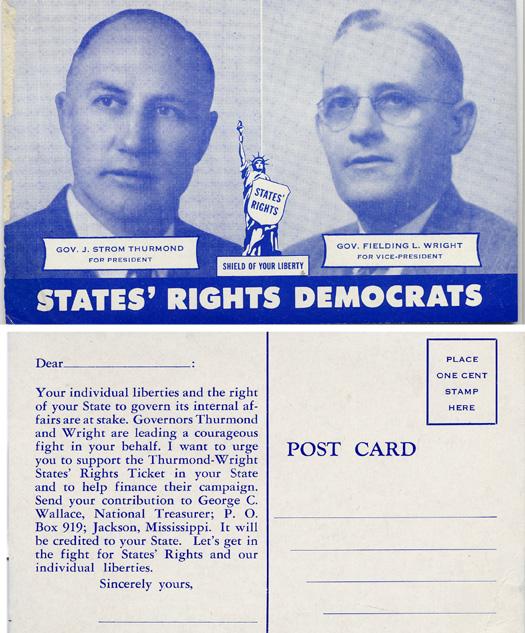
In order to believe the unbelievable you have to accept that McMullin, a conservative Mormon, could win Utah - arguably a bit of a stretch (four points to be precise, or precisely the margin of error). You then have to believe - arguably not so likely, though in light of the polls of late, continued disenchantment with the Clinton campaign, and the stated intentions and substantial efforts of WikiLeaks, it should be noted that it has not too long ago been a reality - the election will be close enough for no party to reach the gloated number 270, an event last occurring in 1824 (despite the best efforts of Governor Thurmond and First Gentleman Wallace to subvert the efforts of the party which did elevate them into office and prominence). If so occurred, the choice otherwise inherent to the much loathed Electoral Collage would be dropped, under the rules of the Twelfth Amendment, into the lap of the even more loathed House of Representatives.

Anything but a landslide for Democratic candidates would leave the House, and thus its fifty individual delegations, safely in Republican hands - of whom sixty-something currently have pledged not to lend Trump a Newton's worth of support. Anything but a strengthened majority for the Grand Old Party, a huge stretch now, would leave the selection at the mercy of a section of self-announced Trump-haters, and with the disapproval of the Republican leadership past seething and utterly lacking confidence in its own nominee, it is safe - perhaps even reasonable - to assume such might be found ub an absolutely unknown Arabic- and Portuguese-speaking Mormon and former CIA operative (two reasons to the this rare condition) and thus elevate the second non-partisan - a nobody of a record-low 40 years, with no political experience from a state, a denomination long on the fringes - to the highest of offices.


Al Wajjah Rayiys? O Rosto de um Presidente?
Sorry... in the tongue of the Prophet; "(is this) the face of a president"?

The real stickler is that even under tight contest, McMullin - repeat the name again, make it stick - would have to break the barrier left unbroken since said Wallace's candidacy in 1968 - if you see the ad, scream loud if any point seems familiar - now (as then) explicitly grasped for this goal, and win a bag of electoral votes for himself, thus qualifying for the select three - a three which, the last and second time the Twelfth Amendment kicked in, included illustrious men such as William Harris Crawford, John Quincy Adams and Andrew Jackson.

Could this feat be possible? I have just outlined it. (A later poll, I can say now, put McMullin one point ahead of Clinton, one behind of Trump; a still later one in the lead, with four points advantage over Trump, seven to Clinton.) What is arguably more concerning would be the popular mandate of a leader who would poll in single digits, nationally. But as just suggested in above example, where the illustrious, well-travelled and unabashedly intelligent Quincy Adams was carried into his ninety-year old father-predecessor's office on the back of a mere seven states, and given the lack of disenchantment and distrust in Mr McMullin's character and judgment - a quality shared by all otherwise qualified Americans passing the Grand Central Terminal on a good day - a Ralph Nader-unlike scenario, with only consequences far more dramatic in their immediate content, should not be ruled out.


A historic result, regardless of winner. The question is, could it herald the outcome, and a second Independent president, on the national stage? A later poll put McMullin at 31 %, overtaking Trump at 27 points and Clinton at 24, with Johnson collapsed.

In light of the absent agenda of the former Secretary of State, the rebuking of her campaign campaign is amazing, heart-warming, but as hollow as the 26 %-plurality and possible victory in the redder-than-most Beehive State. The outrage over a Twitter rant to repeal the 19th Amendment, a sheer piece of trolling meant to highlight a proposal which would supposedly hand the election to the virtue of male Americans, and thus to Trump (which it would not - presuming congressional approval and no legal interference, the issue would be thrown back to the states and their respective constitutions and Bills of Rights, where mostly female-majority electorates would have to, in most cases by referenda, approve of said limitations separately for the proposed change to take effect - now tell me you are offended) does imply a preference for a high turnout, high on my wishlist, but not even this victory-heralding measure is followed by solid, plausible ideas how to make this effort more likely, in a year of the dreadful.

To those solidly behind the Clinton campaign, my challenge stands; find me a set of policy proposals, say three, issued by and in your view likely to be enacted under Clinton. Exempli gratia; a wall along the Southron border, a redefined, pay-or-we-won't-come-and-play NATO, a strong tariff on foreign-produced manufacturers (did I say Mexico?), a blanket ban on migration from Muslim/terrorist cuntry's, something "far worse" than waterboarding, and every acronym relating to free trade in tatters at the bottom of the dustbin. Again; Glass-Steagall reinstated, a federal tax rate reaching 90 %, Medicare-for-all, free community college, free childcare across the Union, and a moratorium-turned-ban on the federal death penalty. So far, no good answers, no real takers - admittedly, an answer in itself. With Trump and Sanders, the two great outsiders of the year, perhaps of the century, this was easy and often condensed into oft-repeated, if yet robotic or appalling slogans.


Could anyone have expected Donald Trump to receive double digits in a presidential election back in 2012, or 2008? Who will be there in 2020, or 2024? Knowing what you know, who will you rule out from certainty?

The relative unlikelihood of the three-way scenario in Utah, and how it could conceivably alter the result on the national stage, should at any rate give pause for sound reflection. The resounding defeat of elephant and donkey has in some sense been achieved, as signified by the incredible stand of two candidates so widely despised that the early, and well-funded - though not necessarily in the sense of big capital - triumphs of Sanders and Trump seemed to shake the very system in which they could not long ago have expected no shares.

Since his triumph, Trump has been all but excommunicated from the GOP, and Sanders has already slithered out of the hide which he, if yet gratefully and leaving much in return through his audacious effort, tried to fit, and stretch to accommodate his more radical preferences. What remains to be seen after the defeat of the outsiders and the re-demarcation of the two-party system is the rise of a credible third option. I believe, given one more financial meltdown, that Gary Johnson could repeat and keep climbing (an deliberate analogy) into double digits, or second place. Worse, and perhaps more likely, we might see a protectionist, populist candidate in reach of the White House, in a mock repeat of the astounding year 1912.

These labels, I allow, may be applied to Sanders as well, and public pressure on both candidates - made available by the primaries which ought to be the envy of the world, now much its freakshow of smear and superficiality - will inevitably lead either to accommodation of the fortress to fit the mainstream, or the reinforcement to make the mainstream even more peripheral. Whichever course is triumphant, we will see trends of both, tending towards the former. Wilson rebuked Bryan upon returning the Democratic Party to the academics, the snobs, to New York and New England elites, but his eight years saw as wide-reaching, cataclysmic, everlasting impact such as a permanent Federal Reserve; a non-sexist franchise across all the Union; the internationalist-minded policeman, his baton exposed and falling; prohibition of alcoholic beverages (arguably not his achievement, nor more "everlasting" than the others). Roosevelt, rebuked by Taft (arguably with a vengeance - but let us not forget venerable Vermont or Utah) saw his party undergo changes that two presidential races later had seen the rise of a presidential administration almost perfectly antithetical to his own, having seen the beginning of gradual leaching of progressives to the still-segregationist Democrats, and the subsequent geographical re-orientation of the national parties, both so recently completed (and yes, Georgia is still into its first ever Lieutenant Governor).

Sanders and Trump, who if they shared this stage would have been older than any couple yet so close (more than twice as many adult years to Nixon-Kennedy in 1960, a debate often referred to for its groundbreaking superficiality, but which old George rightly pointed to as a seemingly lost era of policy and politeness, and now I will too) will affect the parties they selected - both of whom spurned them - long after they are gone. And though both may have fallen short in their ambitions - at least I hope I can say that, when the last ballot has been cast - they may be far more remembered, as well as memorable, than the institutions they rallied against, or that rallied them against themselves, than the guardians preaching their maintenance in the name of letting a lesser devil out of the box.


Such a journey, so little time. Lincoln, born on the same day as Charles Darwin; two great emancipators, though the fate of the Grand Old Party may lead one to instinctively reject the progress and optimism of Darwin's thesis.


Bryan, who consumed the Democratic Party in full - thrice nominated, never victorious, but the time that saw the then, since-forgotten Populist Party came to change existing parties beyond recognition.


Would anyone have believed it? Will you, the next time, or merely see a single step in a continuing journey? Who will succeed, who did lead?


onsdag 12 oktober 2016

Trump's Thermidor


What may yet be referred to as the Republican "leadership" – after a long descent through denial, anger, acceptance, bargaining, denial of a different brand and, finally, full-throttled anger and what must be a great swag of depression, if not publicly weathered – was aroused last weekend, with several senators and a multitude of not too colourful, but clearly resenting voices calling for the man chosen by its own National Convention – a compound nearly banished from our vocabulary, not for obscure reasons – to steer the course through a tumultuous contest either to step down at own volition or be forcibly uncrowned and replaced. How well the hitherto obscure Governor Pence would fare in an election once expected to carry Republican favour I cannot say, aside that I would not stake many a penny in his favour. Asides the sordid case of late nominee Horace Greeley in 1872 (and possibly the sordid case of Thomas Eagleton one century later) I can find no comparison to this eventuality. At any rate, the possibility for a peaceful resolution is in vain. The game is now on, the issue of arrest - and, who knows, what else - warranted, the tiny, loyal clique of supporters decidedly shackled to the fate of their leader walled up in a proverbial Hôtel de Ville, awaiting the apparent onslaught as the final, desperate appeal to the people to whom it has posed such an audacious and unique offer is made by a visibly shaken leader – seemingly broken, perhaps prescient of an outcome already occurring. All left now is the shorter way out, to make the exit before the otherwise defining and decidedly humiliating chute. For as the great Anthony said; "When the fall is all that's left, it matters a great deal." The art of a great deal, one might say.


The night is over; the immovable strongman, so recently so cherished, and feared, inexorably moving and rebuking minions and equals alike... now paid undue respects by his just as many detractors.

Because where there was previously discontented silence, and the occasional, not-too-sassy stand on principle, the board of a game thought determined and locked by the National Convention has been violently overwrought in general revulsion from a leadership long willing to act the audience and either fleece from, or isolate the outcome to its sole actor - most cynical stand, and dangerous for the very republican ideal on which the most influential political party in the history of the republic – some would say in history - bears its name. Most sensationally, though perhaps surprising no one, Speaker Paul Ryan publicly disallowed the same actor's presence at the recent event in Elkhorn, Wisconsin. The unlimited amnesia, not to say forgiveness, of social conservative or Evangelical voters towards a man who a generation past could hardly be fathomed as a nominee even with a psychic ability to predict controversy far exceeds my incredulity, but has after this revelation, a deliberate choice of word, now definitely drawn a line between those who demand from their presumed leaders at least a fraction of the piousness they proclaim in themselves, if yet with the burden of proof strongly lodged on the back of their chosen to disprove rather than earn, and those whose pursuit of sheer adulation for the premier office - not just of the first state born from the Enlightenment, but for all humankind - is a matter of spur and emotional, momentary pragmatism. Likewise, the reactions of the most critics is astounding. For anyone to gasp in offense at the last line of quotes repeated and re-issued and suggest a line has now been crossed, there must be either a strong obsession with Donald Trump - a quality I share not, nor do I regard it as particularly useful - or some very elusive form of embarrassment. Nevertheless, that controversy can make strange bedfellows is as true as the opposite, and the current upheaval seems to have made at last a halt in this supreme of contests. With weeks left to the final phase, a party divided against its nominee - a fact long-since known, undercut temporarily as applause drowned out laughter and contempt - now painstakingly stated in unprecedented excommunication. I believe this to be seen as the bullet irretrievably lodged where it is most undesired, from whatever quarter you say it was delivered.

For this halt, which ought have happened far earlier if its power was to be harnessed, rather than an obstacle to the conservative movement, there are a multitude of good reasons - most lately, even promises, on live television, of outcomes which even a special court can make by its own judgment, which subjects the question of Trump's intentions and aims to questions requiring further scrutiny or, in the absence of executive experience - of which he has none - speculation on very hard facts. To believe the "malignant clown" (Mark Kirk's words and, yes, I know of his stroke, but even if you have just posed he thus did conflate the Illinois' own, deceased entrepreneurial psychopath with his party's nominee, the proposal that he might have ought to frighten as much as the term itself) to surrender would, knowing everything about his oft-mentioned temperament, be as presumptuous as his own expectations of the feats of an administration yet to be dawned. With or without a speedy change of captain, the Republican galley seems sure to continue the voyage onto the rocks of resenting popular opinion under the auspices by its disowned figurehead.

The question now is, with the party unleashing a wave of long-held discontent, which of many factions and even more oarsmen toiling the primaries will emerge supreme in 2020? I will not believe that the party which will hold he House for at least two more years is yet to collapse, nor that Democrats will resurge as the unquestioned beacon it once was - that is, when it was a bridge divided between the rantings of Teddy Bilbo and the oratory of Hubert Humphrey - without a convincing turn-around. The results of the eighth is a contest lost rather than won, asides from the supreme title to be inscribed at he top of a resume likely never again to be used - in my contention, the first and last object of "both" candidates. What is left to see which path would be taken, with this greatest of peaks scaled.


Hey, guys? Guys? How are you? Great! Ready to strap anti-tank guns and march into Russia, if I demanded it? I doubt it, just as I doubt he could connive it – except through carelessness.

More than once, by fools and otherwise thoughtful commentators, the Republican nominee's rise has been heralded, near-prophetically (and as I have claimed, there is much reason to distrust prophets, especially those who claim continuity) second coming of Hitler, which seems to hint of a lacking registry of candidates, as well as equating the concept of populism and demagoguery - two attributes present in the Nazi dictator, and also many, many others - with the uniquely positioned existence in history of a movement and a shepherd so convicted, so synchronised that they could be far more beloved, far more powerful, and far more destructive than most good efforts of a century, many centuries of destructive amoral annihilists. Indeed, if one were to level a stronger case against Mr Trump than bigotry, a whimsical repudiation of constitutional restraint and the willingness to turn his critics' most arbitrary or indefensible (and thus useless as arguments) attributes as means of crude verbal assault - self-evidently opportunistic in his case, and wavering as soon as confronted about it - and put them next to more precarious areas such as consistency in ideology, degree of commitment to a genuine cause, and operational knowledge of foreign policy. Whatever else may been, or should be repeated or the German butcher, I would claim all three pendula to swing in Trump's disfavour. Indeed, assuming his mother were an aunt of my preferred Democratic nominee - yes, my views are probably closer to hers (though arguably we will never know, will we?) but you know who I am talking about, and I haven't had to explain why - the Donald's public persona would represent an almost unimprovable stereotype of America Horrida; uncultured, greedy, inconsistent, stupid, of mixed origin and emergent from a culture of management, cheat and deal-making rather than leadership, loyalty and sacrifice. Trump is an echo of Lucius Domitius Ahenobarbus (otherwise known as Nero) or conceivably of Shakespeare's hunchback with a callosal commissure brought in level with his spine - not of the Austrian kitsch painter.


Which would be worse? Think carefully, before you let enmity decide who you select for a representative.

The Donald's attempt at a riposte, though not without an astounding weight of Tu Quoque, has indeed a pointed end insufficiently exposed by Trump's critics and hardly ever repudiated by Mr Clinton's defenders, in answer to Mrs. Clinton's attempts to pose as a vindicator of the suppressed, the small, those whose hard-working existence lack the offered hand of lucrative fundraising connections to improve a harsh, struggling existence to a flourishing one. Regard these many elusive yet undeniable facts, the relative silence of the press, or tendency to wave away even substantially documented accusations as mere tools of a pure opportunist - which, as you already note, do not dilute her her claims to be the same title, unlike the kingship one of great collegiality - does pose a disgrace to the two guardians of political freedom; the public and the media, and herald the decline of the wit and strenuousness of both to safeguard these institutions.


The past, the future? I would say the past and the present joined, and ask - with a sordid tongue - what the future is to bring.

The winds of and a reason late awakened are unlikely to turn - and if I were to come with a more audacious, as well as arguably optimistic expectation, I expect the great scion of Bordeaux to come up strong against the Nicolas, and sweep the road into the Elysée Palace ahead of the otherwise second female head of an official nuclear power (and the third greatest arsenal at that) the coming spring. And as the tide will wash again, for the first time since Andrew Jackson, a Democrat to be succeeded after two full terms by virtue of election, there is the painstaking question what this future holds, and what promises it will keep. The campaign, with the former in store as a strong contender, has been the most filthy and "de-issued" in late history, and to relish that the worse of two devils faced a sordid defeat will prove scant consolation once the words and paper of inauguration day has long been lost to bleak and chilling winds.


Watching the times. Please, stay in them.

It is time to think, and stop only to avert disaster, what is to be the future that lies beyond the administration unusually optimistically heralded once - and yes, I remember it - with clamours of "Hope" and "Change". While Obama could deliver passion in abundance alien to the deep and needy days of a financial collapse whose extent we, at the end of his chapter in the book of presidents still ponder – and wisdom yet to be molded and evaluated through the emerging decades - the Barras who now emerges through the halls – seemingly confident, but to the clamour of what, except the relief of what may just have been averted? - may be a beacon of stability and consideration, perhaps even consensus, but marked with a historical importance that will be exhausted before her reign even began. It is time to reflect on the time beyond the laying the groundworks. There is time now for proper thinking, and proper leadership to arise, in the marketplace of ideas if not yet in the halls of temporal power.


If properly weathered in Swedish, please check out my brief conclusion on the two candidates and the prospects as I saw them last summer. With regards to a more precise weighing of the candidates, I think Sam Harris has it right, twice - or near enough to make scant difference. Shaped in my own words and boiled down to a single sentence; if I lived in a state with a substantial Democratic majority, I would sure as as a hot oven is an insufficient metaphor for a place of unimaginable and eternal torment be tempted to put my mark in the box next to Johnson or Stein. That, again, should be construed as something other than preference or confidence in their abilities or qualifications.

And yes, the Joffrey v. Cersei analogy is clear and deliberate. I believe them, from the major characters of Mr. Martin's great series, to best represent the faces of the donkey and the elephant this year. Let us see, and hopefully soon, and in a forum more suitable "for better or for worse", how that preference plays out :P